How to Choose the Right CPAP Machine: A Complete Australian Guide
Author: CPAP Club Date Posted:28 April 2026
Getting a new CPAP diagnosis can feel overwhelming, and choosing the right machine is one of the first big decisions you'll face. With several machine types, a range of comfort features, and trusted brands including ResMed, Fisher & Paykel, Philips Respironics, and Löwenstein Medical all offering strong options, it's easy to get lost. This guide cuts through the noise and walks you through exactly what to look for — so you can choose a CPAP machine that works for your sleep apnea, your lifestyle, and your nightly routine.
Understanding the Different Types of Positive Airway Pressure Machines
Not all CPAP machines work the same way. The term "CPAP" is often used loosely to describe all positive airway pressure (PAP) devices, but there are three distinct types — and the differences matter.
Fixed Pressure CPAP delivers one constant air pressure throughout the entire night, exactly as prescribed by your sleep specialist following your sleep study. It's straightforward, reliable, and generally more affordable. Fixed pressure machines suit patients whose pressure requirement is stable and who tolerate a consistent setting well. A strong option in this category is the Löwenstein Prisma SOFT Max — a German-engineered device with Forced Oscillation Technique (FOT) for precise event detection, a large 400ml dishwasher-safe humidifier chamber, and full Prisma CLOUD telemedicine connectivity. Browse our full range of Fixed Pressure CPAP machines.
Auto-Adjusting CPAP (APAP) monitors your breathing on a breath-by-breath basis and automatically adjusts pressure within a prescribed range throughout the night. If your apnea events vary — due to sleeping position, congestion, alcohol consumption, or changes in weight — an auto-adjusting machine responds in real time, delivering the lowest effective pressure when you need it least and increasing it when you need it most. This makes APAP the most popular choice for newly diagnosed patients and those who want greater comfort flexibility.
One practical advantage worth knowing: most APAP machines can also be configured to run at a fixed pressure via the device menu settings. So if you start on auto mode and your sleep specialist later determines a single consistent pressure is more appropriate, there's no need to buy a new machine — it's simply a settings change. Leading auto-adjusting machines available at CPAP Club include:
- ResMed AirSense 11 AutoSet — Features a responsive colour touchscreen, the built-in AutoSet for Her algorithm, SmartStart, AutoRamp with sleep onset detection, and Care Check-In coaching via the myAir app. One of the most clinically published APAP algorithms available.
- Fisher & Paykel SleepStyle+ — The only CPAP machine to receive the American Arthritis Foundation's Ease of Use Commendation. A single large forward-facing button navigates the entire menu. Features SensAwake™, which detects wakefulness throughout the night and automatically reduces pressure to help you drift back off, plus ThermoSmart™ humidification that auto-adjusts based on ambient humidity levels.
- Philips DreamStation Auto — A compact, low-profile auto-adjusting machine with a front-facing display operable from lying down, SmartRamp, EZ-Start acclimation mode, Dry Box Technology to prevent water damage, and Bluetooth connectivity to the DreamMapper app. FAA-approved for in-flight use.
- Löwenstein Prisma SMART Max — A premium German-engineered APAP device with two dynamic pressure adjustment modes, the proprietary softPAP exhalation relief, deep sleep indicator (Prisma RECOVER), and full Prisma CLOUD telemedicine connectivity for remote monitoring and settings adjustment.
- Löwenstein Prisma 20A — Uses Forced Oscillation Technique (FOT) to distinguish obstructive from central apnea events and deliver targeted pressure adjustments. Includes softPAP comfort relief, cloud telemedicine access, and detailed data storage for 365 days.
Browse our full range of Auto Pressure CPAP machines.
BiLevel (BiPAP) machines deliver two distinct pressure settings — a higher pressure during inhalation and a lower pressure during exhalation. This makes breathing out against the machine significantly more comfortable and is generally prescribed for patients with higher pressure requirements, central or complex sleep apnea, or certain respiratory conditions. BiPAP therapy always requires a prescription from your sleep specialist. Options in this range include the Löwenstein Prisma 25ST, the ResMed AirCurve series, and the Philips DreamStation Auto BiPAP. View our range of BiLevel / BiPAP machines.
Which type is right for you? Your sleep specialist will guide this decision based on your sleep study results and clinical requirements. Most newly diagnosed patients with obstructive sleep apnoea are prescribed either a fixed or auto-adjusting machine.
Key Features to Look For in a CPAP Machine
Once you know which machine type you need, there are several features worth comparing between models. Here's what matters most in day-to-day use:
- Ease of use — A clear, intuitive interface makes it easy to start therapy, adjust comfort settings, and review your nightly results without frustration. The ResMed AirSense 11 uses a responsive colour touchscreen for tap-based navigation; the Fisher & Paykel SleepStyle+ uses a single forward-facing button that handles the entire menu — earning the American Arthritis Foundation's Ease of Use Commendation. The Philips DreamStation features a front-facing display that can be operated while lying down. Löwenstein's PrismaLINE devices share a consistent, intuitive menu across the range, making upgrades within the family straightforward.
- Built-in humidification — Dryness and nasal irritation are among the most common reasons people struggle with CPAP. A heated humidifier adds moisture to the air before it reaches your mask, making therapy significantly more comfortable. The Löwenstein Prisma SOFT Max includes the PrismaAQUA humidifier with a 400ml dishwasher-safe chamber — the largest water capacity on the market — and a heated rod rather than a heating plate, meaning no cracking or leaking. The Fisher & Paykel SleepStyle+ features ThermoSmart™, the only CPAP humidification system to automatically adjust output based on ambient humidity levels.
- Heated tubing — Pairing a humidifier with a heated tube prevents moisture from condensing inside the hose (known as "rainout") and maintains consistent air temperature from machine to mask. The SleepStyle+ uses AirSpiral™ heated tubing for particularly effective condensation control. Löwenstein's PrismaHYBERNITE heated tube uses an integrated power source for seamless performance.
- AutoRamp and sleep onset detection — Ramp mode starts your machine at a lower pressure when you first put your mask on and gradually increases to your therapeutic level as you fall asleep. The ResMed AirSense 11 and Philips DreamStation both include ramp with sleep onset detection. The SleepStyle+'s SensAwake™ goes further — it monitors wakefulness throughout the entire night and reduces pressure each time you wake, helping you fall back asleep at any point.
- SmartStart / Auto Start — Many machines detect breathing into the mask and start therapy automatically, without pressing a button. The ResMed AirSense 11 and Fisher & Paykel SleepStyle+ both include Auto Start/Stop as standard. Löwenstein PrismaLINE devices include autoSTART as a standard comfort feature.
- Quiet operation — Modern CPAP machines have become remarkably quiet. The ResMed AirSense 11 AutoSet is rated at approximately 27 dBA; the Fisher & Paykel SleepStyle+ and Löwenstein PrismaLINE devices are similarly whisper-quiet. All are considerably quieter than older-generation machines. If noise is a priority, check the manufacturer's published sound level specification for any model you're comparing.
- Expiratory pressure relief — This feature gently reduces pressure at the start of each exhalation, making it easier to breathe out against the machine. ResMed calls this EPR™, Löwenstein calls it softPAP, and Fisher & Paykel offers Expiratory Relief — different names, same core benefit. Particularly helpful for patients who find constant pressure uncomfortable when first starting therapy.
- Over-the-air software updates — Newer machines receive automatic firmware updates via cellular connectivity, so your device benefits from algorithm improvements and new features without any manual effort. The ResMed AirSense 11 and Löwenstein Prisma 20A both support over-the-air updates.
CPAP Machines Designed for Women
Sleep apnea in women presents differently to sleep apnea in men. Women tend to have a higher proportion of hypopnea events (partial airway obstruction) and are more likely to experience respiratory effort-related arousals — patterns that older algorithms weren't optimised to detect or respond to.
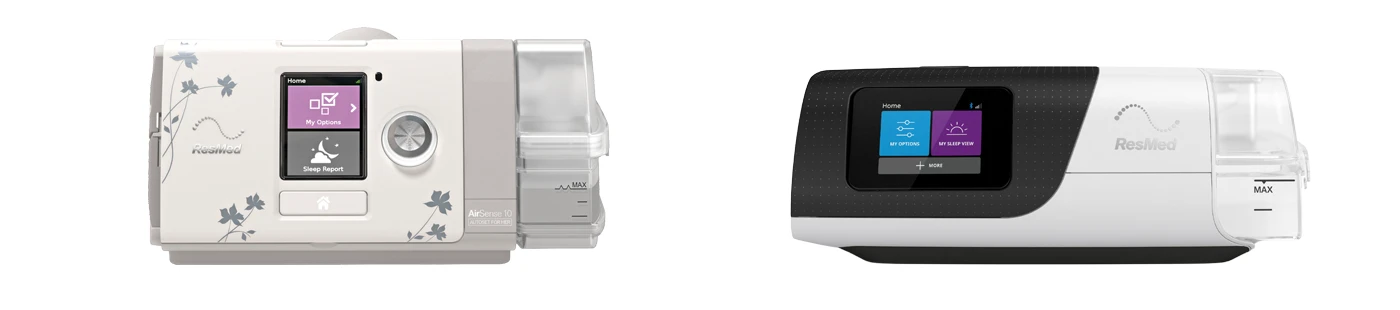
ResMed's AutoSet for Her algorithm addresses these differences directly. In the AirSense 10 range, a dedicated "For Her" device was required to access this therapy mode. With the ResMed AirSense 11 AutoSet, the AutoSet for Her algorithm is built into the standard machine as a selectable mode — no separate device required. The Fisher & Paykel SleepStyle+ is also worth considering, particularly for women who prioritise physical ease of use — its single-button control system and compact all-in-one humidifier design make nightly setup straightforward from day one.
Should You Consider a Travel CPAP Machine?
Portability is worth thinking about even if you largely stay at home. A travel CPAP machine can be a practical backup or a genuine lifestyle upgrade if you travel frequently for work, camping, or holidays.
Key things to consider when evaluating travel machines:
- Size and weight — smaller is better for carry-on bags
- Power compatibility — does it run on both mains power and a travel battery?
- Mask compatibility — some travel machines are limited to specific mask types
- Humidification — waterless or water-based, and how easy is it to manage on the road?
- FAA clearance — if you plan to use the device on aircraft, confirm the manufacturer's specification
Browse our full range of travel-size CPAP machines to find the right portable option for your needs.
Sleep Data and App Connectivity
Monitoring your therapy is one of the most powerful tools for long-term CPAP success. Modern machines transmit nightly sleep data wirelessly — so both you and your care provider can see how therapy is tracking without a clinic visit or data card hand-off. Each brand takes a slightly different approach:
- ResMed — The myAir™ app connects to AirSense machines via Bluetooth and cellular data, delivering a daily therapy score, AHI results, mask leak data, and usage hours. The AirSense 11 adds a Personal Therapy Assistant with voice-guided setup instructions and a Care Check-In feature for personalised coaching during your first month. Find out more about accessing your machine data.
- Fisher & Paykel — The SleepStyle+ connects via its built-in 4G cellular modem to the F&P SleepStyle App for automatic nightly data transfer, with therapy alerts and progress tracking. A SmartUSB stick is also included for manual uploads when cellular coverage isn't available.
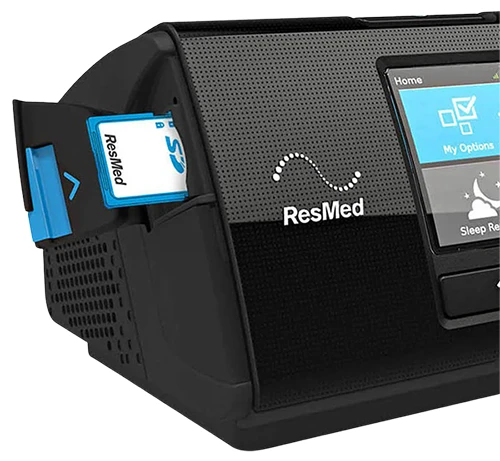
- Philips — The DreamStation connects via Bluetooth to the DreamMapper™ app for daily therapy reports, usage tracking, and mask fit alerts. An SD card is also included for uploading to third-party platforms.
- Löwenstein — The Prisma range connects to Prisma CLOUD — a telemedicine platform allowing your care provider to access nightly data, adjust settings remotely, and monitor therapy without an in-person visit. The Prisma APP provides personal therapy tracking, goal setting, and the ability to share reports with your doctor. High-resolution data is stored for 14 days, with full statistical data available for 365 days.
New to CPAP? Consider a Package Deal
If you're starting therapy for the first time, a CPAP package deal is often the most practical and cost-effective way to get set up. Packages bundle your machine with a compatible mask and, in some cases, additional accessories — so you have everything you need from day one, without the guesswork of matching components separately. View our CPAP package deals.
Frequently Asked Questions: Choosing a CPAP Machine
Do I need a prescription to buy a CPAP machine in Australia?
Fixed and auto-adjusting CPAP machines can generally be purchased without a formal prescription in Australia, though a sleep study is strongly recommended before starting therapy — your prescribed pressure settings are based on your individual results. BiPAP / BiLevel machines typically require a clinical prescription due to their dual-pressure settings and the complexity of the conditions they treat. If you have a prescription from a sleep specialist, you can upload it here and we'll configure your machine settings before dispatch.
Is an auto-adjusting CPAP machine better than a fixed pressure machine?
Not necessarily — it depends on your needs. Auto-adjusting machines are often more comfortable because they deliver the lowest effective pressure at any given moment, rather than a constant level throughout the night. They suit newly diagnosed patients, those whose pressure requirements fluctuate, and anyone who has found a fixed pressure uncomfortable. That said, many experienced users prefer the simplicity and lower cost of a fixed pressure device once their optimal setting is established. It's also worth knowing that most APAP machines can be switched to run at a fixed pressure via the device menu — so you won't need to buy a separate machine if your therapy requirements change.
How do CPAP machine warranties compare across brands?
Warranty terms vary meaningfully between brands and are worth factoring into your purchase decision, particularly given the investment involved:
- Fisher & Paykel SleepStyle+ — 5 years total (2 years standard + 3 years extended, which is included automatically when you register your device within 30 days of purchase). One of the most generous standard warranty packages in the Australian market.
- ResMed AirSense 11 — 2 years standard, extending to 5 years total when you activate the Sleepvantage membership registration after purchase. Registration is required to access the full 5-year term, so don't forget to do this shortly after your machine arrives.
- Philips DreamStation — Warranty terms vary by model. Check the individual product page for the specific device you're considering before purchasing.
- Löwenstein Prisma — Warranty terms vary by model. Löwenstein devices are manufactured in Germany to high engineering tolerances. Check the individual product page for details.
In all cases, keeping your proof of purchase and completing any required registration promptly after delivery is important to protect your full warranty entitlement.
What's the quietest CPAP machine available?
Most leading machines today operate between 26 and 28 decibels — roughly equivalent to a whispered conversation. The ResMed AirSense 11 AutoSet is rated at approximately 27 dBA; the Fisher & Paykel SleepStyle+ and Löwenstein PrismaLINE devices are similarly whisper-quiet. All are substantially quieter than older-generation machines. If noise is a top priority, check the manufacturer's published sound level specification for any model you're considering.
How long do CPAP machines last?
With proper care and maintenance, a quality CPAP machine typically lasts 5–7 years. Regular cleaning, timely filter replacement, and firmware updates on compatible models all contribute to device longevity. Warranty coverage — especially the 5-year coverage available from both Fisher & Paykel (standard with registration) and ResMed (upon Sleepvantage registration) — provides meaningful peace of mind over that period.
Can I use my CPAP machine when travelling overseas?
Most modern CPAP machines are built with auto-switching power supplies that operate on both Australian (230V) and international (110V) current, making them compatible with most countries' power standards. You'll need the appropriate plug adaptor for your destination. The Philips DreamStation Auto is FAA-cleared for in-flight use. Check your specific model's specifications before travelling, and see our CPAP travel guide for more tips.
The Right Machine Is the One You'll Use Every Night
Ultimately, the best CPAP machine is the one that keeps you comfortable and compliant — night after night. Comfort features, data visibility, warranty coverage, and the right machine type for your therapy needs all play a role. Take time to consider your priorities, talk to your sleep specialist about your prescription requirements, and don't hesitate to reach out to our team if you'd like guidance matching a machine to your needs.
Ready to browse? Explore our full range of CPAP machines and CPAP package deals — with free delivery Australia-wide.